
3D Printing Service: Fused Filament Fabrication
Our fused filament fabrication services offer:
- Biocompatible Materials
- High-Performance Components
- Cost Efficient Prototyping
- Instant and Engineer-Assisted Quotes
- Certifications: ISO 9001, AS9100D, ITAR, and CMMC Level 2
- Instant and Engineer-Assisted Quotes
- Certifications: ISO 9001, AS9100D, ITAR, and CMMC Level 2
-
Instant and
Engineer-Assisted
Quotes - 100+ Materials
-
40+ Surface
Finishes -
Certifications:
ISO 9001, AS9100D, ITAR,
and CMMC Level 2 -
In-House Services: 3D Printing,
CNC Machining, Urethane Casting,
and Sheet Metal Fabrication
Digital Manufacturing Made Simple.
Upload your manufacturing project’s CAD file.
We review your file and provide manufacturability design (DFM) feedback.
We complete precision manufacturing using certified processes.
Our team ships the finished project to you anywhere in the USA.

What is fused filament fabrication?
Fused filament fabrication is a versatile additive manufacturing process that works by extruding a heated thermoplastic filament and depositing the material in layers to create three-dimensional objects. This technique enables the production of complex geometries and customized parts, making it a popular choice for rapid prototyping, small-batch production, and the creation of custom parts across various industries.
How does a fused filament fabrication 3D printer work?
In our FFF process, customers create and submit a 3D model of the object they need using computer-aided design (CAD) software. Once we receive the CAD file, here’s how it works:
- We use slicing software to prepare the model for printing, dividing the model into thin layers and generating a set of instructions for the printer to follow.
- These instructions include details such as the temperature at which the filament should be melted, the speed at which it should be extruded, and the nozzle’s position.
- The printer feeds the filament and softens it using a heated nozzle or extruder.
- The melted plastic is extruded and quickly solidified to form a layer.
- The printer repeats this process for each layer until the object is complete.
- Finally, the object is removed and ready for finishing and post-processing.

Advantages of Fused Filament Fabrication
Fused filament fabrication technology has revolutionized the way products are designed and manufactured. The following are a few of the advantages of fused filament fabrication:
- Fast turnaround for prototypes and production parts.
- Ability to build large, simple parts.
- Supports a variety of materials and colors.
Considerations for Fused Filament Fabrication
While there are many advantages to using FFF 3D printing, there are also some drawbacks, including:
- A less smooth finish compared to other 3D printing methods.
- Low-resolution printing quality that limits the production of fine details or tiny parts.
- The need for support structures during printing.
Fused Filament Fabrication Services at Prototek
Prototek’s fused filament fabrication services deliver production-grade quality with every part. From prototyping to full-scale manufacturing, our comprehensive services ensure that you receive high-quality parts engineered for end-use readiness, meeting the demands of real-world environments. Learn how we can support you at every stage of your product’s life cycle — from concept design to market launch and beyond.
Fused Filament Fabrication Machine Company:
Stratasys
Fused Filament Fabrication File Types:
Max Build Chamber Size:
36 x 24 x 36 in
Lead Time:
1 – 5 Days
Material:
Ultem® (PEI) 1010 and 9085, Polycarbonate (PC), PC-ABS, PC-ISO, Nylon 12CF, ASA, ABS-M30, ABS-ESD7, and other materials may be available upon request.
Tolerances:
- 0.005 layers tolerance = ± 0.005 in for first inch and ± 0.002 for every inch thereafter
- 0.010 layers tolerance = ± 0.010 in for first inch and ± 0.002 for every inch thereafter
- 0.013 layers tolerance = ± 0.013 in for first inch and ± 0.002 for every inch thereafter
Layer Thickness:
The standard layer thickness is 0.010 inch. We can do 0.005 and 0.013-inch layers as well.
- Are you ready to make your manufacturing project a reality, or do you have questions?
Prototek's FFF Materials
Selecting the right material in fused filament fabrication means choosing a filament that best matches your part’s specific requirements. Our extensive material selection allows you to choose the right properties for your application — whether that’s strength, flexibility, or specialized performance.

ULTEM® 9085 (PEI/Polyetherimide)
ULTEM® 9085 is a lightweight yet robust thermoplastic material with proven mechanical and thermal properties. This filament is ideal for various applications, particularly those that require durability and heat resistance.
Tensile Strength
10,000(145) psi
Tensile Modulus
365(9) ksi
Elongation @ Break
5.4(0.5)%
Flexural Strength
14,740(140) psi
Flexural Modulus
348(5) ksi
Heat Deflection @ 264 psi
343° F

ULTEM® 1010 (PEI/Polyetherimide)
ULTEM® 1010 is a high-impact polyetherimide (PEI) resin with inherent flame and chemical resistance. This high-strength, amorphous thermoplastic is a standard in various applications, including automotive, aerospace, electronics, and medical fields.
Tensile Strength
N/A
Tensile Modulus
440(25) ksi
Elongation @ Break
4.0(0.4)%
Flexural Strength
18,475(570) ksi
Flexural Modulus
420(7) ksi
Heat Deflection @ 264 psi
410° F
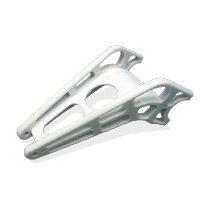
Polycarbonate (PC)
Polycarbonate filament is a versatile and lightweight thermoplastic polymer. This transparent material offers high impact resistance and is common in various components, including electronics, automotive parts, construction materials, and eyewear.
Tensile Strength
8,300 psi
Tensile Modulus
282 ksi
Elongation @ Break
4.8%
Flexural Strength
13,000 psi
Flexural Modulus
291 ksi
Heat Deflection @ 264 psi
261° F
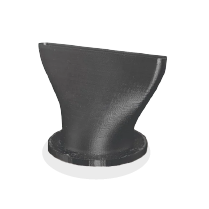
PC-ABS is a filament that blends ABS and polycarbonate. It combines the flexural strength of ABS and the heat resistance of polycarbonate.
Yield Strength
5,300 (110)psi
Tensile Modulus
288 (5.5)ksi
Elongation @ Break
4.7 (0.75)%
Flexural Strength @ 5% Strain
8,970 (170)psi
Flexural Modulus
269 (7.3)ksi
Heat Deflection @ 264 psi
217.2° F
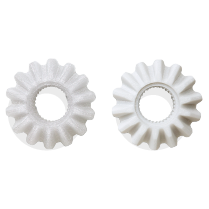
PC-ISO meets the stringent safety standards of ISO 10993-1. Therefore, it is ideal for medical devices, surgical instruments, and implants. Furthermore, its biocompatibility and durability make it a reliable and long-lasting option for these critical applications.
Tensile Strength
8,300 psi
Tensile Modulus
289.8 ksi
Elongation @ Break
4%
Flexural Strength
13,100 psi
Flexural Modulus
310.4 ksi
Heat Deflection @ 264 psi
260° F
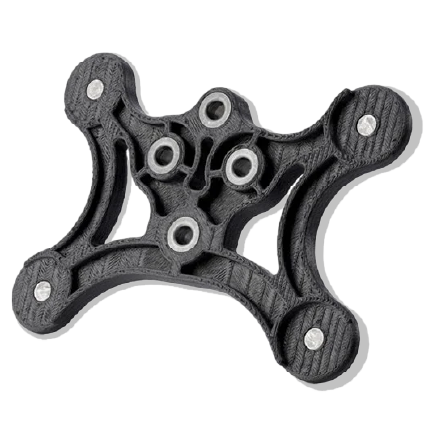
Nylon 12CF
Nylon 12CF is one of the most suitable materials for FFF. Made from Nylon 12 and reinforced with chopped carbon fiber, this unique blend contributes to the resin’s exceptional strength and high stiffness.
Tensile Strength
12,100(250) psi
Tensile Modulus
1,370(67) ksi
Elongation @ Break
2.4(0.29)%
Flexural Strength
22,200(310) psi
Flexural Modulus
1,610(40) ksi
Heat Deflection @ 264 psi
265.7° F
ASA
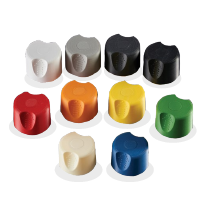
Acrylonitrile styrene acrylate (ASA) is a strong, rigid thermoplastic filament with outstanding durability. This material will not become damaged or degraded in high temperatures or prolonged sun exposure.
Tensile Strength
4,750 psi
Tensile Modulus
290 ksi
Elongation @ Break
9%
Flexural Strength
8,700 psi
Flexural Modulus
270 ksi
Heat Deflection @ 264 psi
196° F
ABS-M30
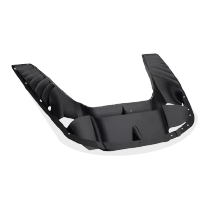
ABS-M30 comprises acrylonitrile butadiene styrene (ABS) and an additive that enhances strength and toughness. It produces functional prototypes, end-use parts, and low-volume production runs. ABS-M30 has excellent dimensional stability, high tensile strength, and abrasion resistance.
Tensile Strength
4,650 psi
Tensile Modulus
320 ksi
Elongation @ Break
7%
Flexural Strength
8,700 psi
Flexural Modulus
300 ksi
Heat Deflection @ 264 psi
180° F
ABS-ESD7
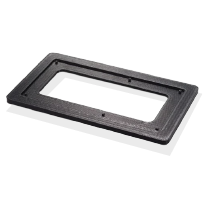
ABS-ESD7 is a blend of ABS polymer and a conductive substance, such as carbon nanotubes, carbon fibers, conductive carbon black, or graphene nanoplatelets. It also protects against electrostatic discharge (ESD), making it ideal for manufacturing and packaging electronic devices.
Tensile Strength
5,200 psi
Tensile Modulus
350 ksi
Elongation @ Break
3%
Flexural Strength
8,800 psi
Flexural Modulus
350 ksi
Heat Deflection @ 264 psi
180° F
Please Note: Biocompatible materials are only biocompatible in their natural state. Once a finish that coats the material is applied (priming, painting, and clear coating), it is no longer biocompatible. Special processing may be required. Please notify us of any biocompatibility needs.
Infill % Via GrabCAD Print Table
GrabCAD Print is software from Stratasys that helps prepare files for Fortus FFF machines, the primary machines used for FFF printing at Prototek. This program simplifies the management of print settings and the arrangement of build layouts, enhancing workflow in 3D printing projects. Options include
- Standard: ASA & ABS-M30/M30i
- Performance: ABS-ESD7, ABSi, PC, PC-AMS, Nylon 12, & Nylon 6
- Premium: Ultem® 9085, Ultem® 1010, PPSF, Diran 410MF07, Nylon-CF10, & ABS-CF10
- High Performance: Antero 800na & Antero 840CN03
FFF Design Recommendations
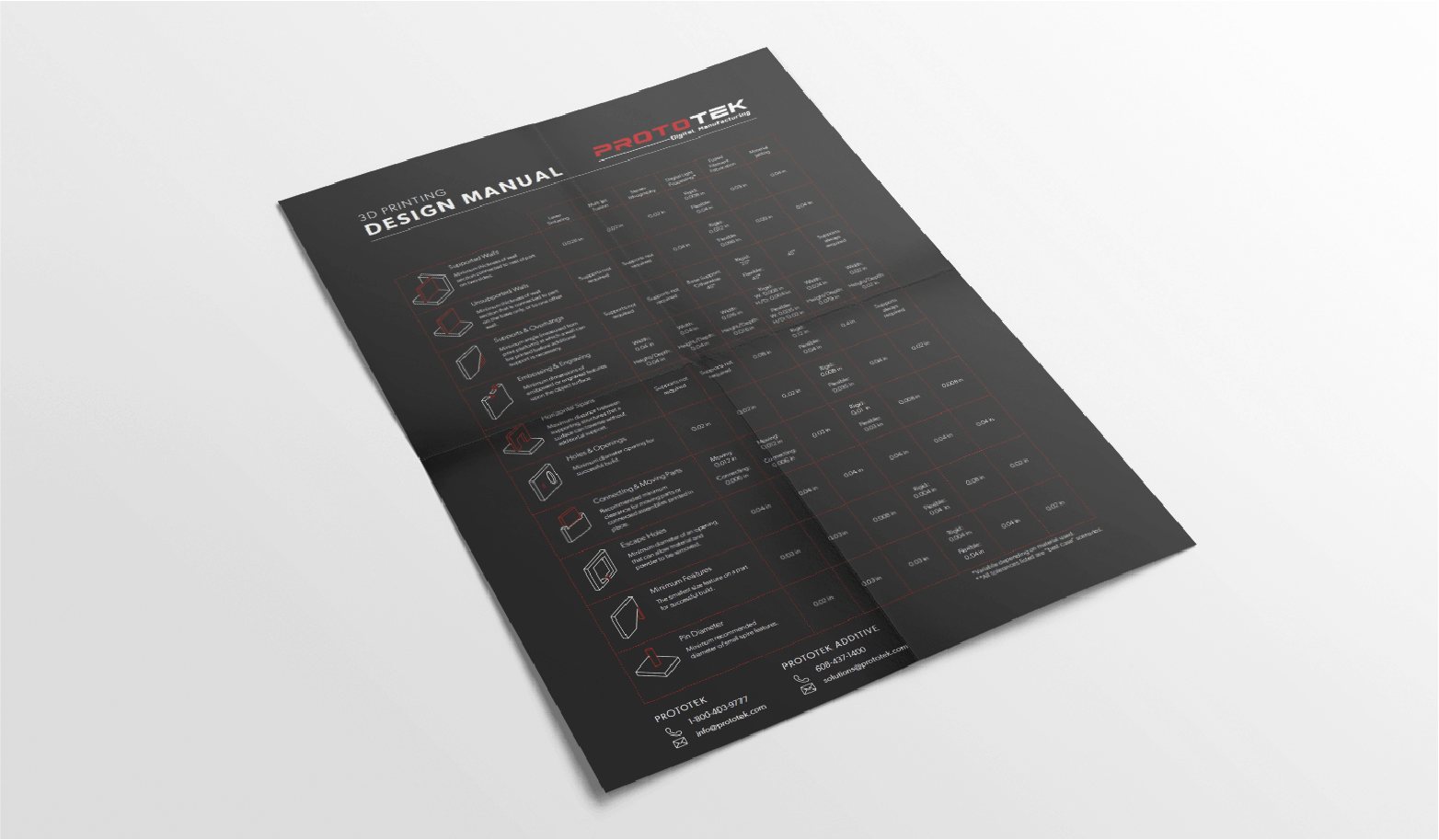
Complex designs often require a high level of support. When designing parts for fused filament fabrication 3D printing, the experts at Prototek can help you consider the following design factors to ensure the quality of your final product:
- Orientation: Ensures your part is strong, accurate, and visually appealing.
- Wall thickness: Avoid thin walls to achieve a consistent, vital part.
- Overhangs: Reduce overhangs using features such as fillets, chamfers, or draft angles.
- Support structures: Place with consideration for functionality and post-printing finishing.
- Material selection: The material chosen will significantly impact the final product’s characteristics, including strength, durability, and flexibility.
Fused Filament Fabrication Finishes
Prototek Digital Manufacturing is pleased to offer a diverse selection of high-quality finishes using FFF that can be customized to meet your precise requirements. Our advanced FFF 3D printers ensure that we consistently produce superior, durable, and accurate printed parts with unmatched reliability, guaranteeing your satisfaction at every stage of the process.
Fused Filament Fabrication Finishes
Learn More About 3D Printing
Through our resources, you can discover the complexities of 3D printing and gain insights into creating top-notch designs specifically tailored for this cutting-edge technology.
Prototek's
Other Additive Manufacturing Technologies


Choose Prototek for Fused Filament Fabrication Projects
Prototek, a leading 3D printing service provider, is committed to delivering high-quality products utilizing our FFF technology. When you choose Prototek, you get more than a superior-quality product — you also gain a reliable partner committed to your every need. Our collaboration includes:
- Utilize state-of-the-art equipment and high-quality materials to ensure precision and high-quality manufacturing of durable and reliable parts.
- An unmatched team of skilled technicians who strive to deliver customized solutions catered to each client’s specific needs.
- Competitive pricing that never sacrifices production quality.
Ready to take your project from concept to production with reliable fused filament Fabrication 3D printing? Get expert guidance on material selection and design optimization from Prototek. Request a quote for our FFF manufacturing services.